
 eGFR monitoring crucial in managing chronic kidney disease progression
 Tracking changes in eGFR can help identify rapid progressors of chronic kidney disease, paving the way for earlier interventions and improved patient outcomes. Summary Key takeaways For more information on a specific study or to connect with the Actionable Insights Committee, Sponsor: Funded by Boehringer Ingelheim Pharmaceuticals, Inc.
Domain(s): cardiometabolic
Background
Chronic kidney disease (CKD) can progress rapidly, increasing the risk of kidney failure, a serious and costly outcome. Identifying patients at risk of this rapid progression is crucial for prevention.
Current methods track changes in kidney function by monitoring estimated glomerular filtration rate (eGFR) over time. However, there is no universally accepted standard for measuring rapid progression, as methods vary in number of data points used and time frame.
Objective
This study aimed to explore how four different methods of calculating change in eGFR, by using slope derived from multiple data points, impact the prevalence of rapid progression and the ability to predict kidney failure.
Methods
We selected patients from the Healthcare Integrated Research Database (HIRD®) who had at least one eGFR result between January 1, 2016, and December 31, 2019. These patients were divided into four cohorts based on the number of eGFR assessments (>2 vs >3) and the assessment duration (one year vs. two years). We defined rapid progression as slope of -3 ml/min/1.73m2/year in eGFR, based on a review of the literature and prior work in this area.
Results
Figure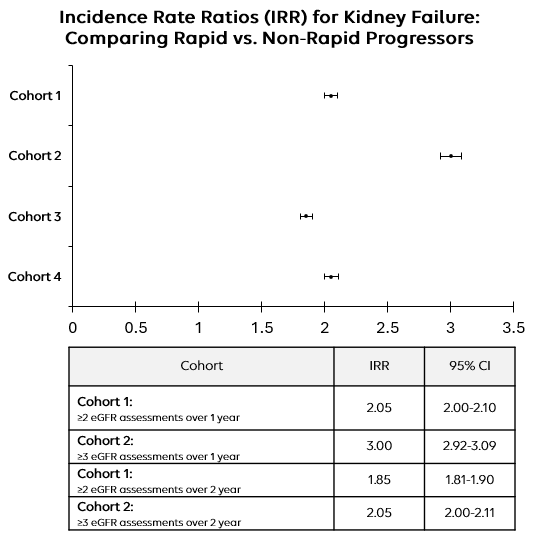
Publications
Carelon Research project team: Emma Richard, Christopher Crowe, Rachel Djaraher
contact us at [email protected].
Dissemination and sharing of the Newsletter is limited to Elevance Health and its subsidiaries, and included findings and implications are for Elevance Health and its affiliates’ internal use only.
Lorem ipsum dolor sit amet, consectetur adipisicing elit, sed do eiusmod tempor incididunt ut labore et dolore magna aliqua. Ut enim ad minim veniam, quis nostrud exercitation ullamco laboris nisi ut.

"Et harum quidem rerum facilis est et expedita distinctio!"

"Nam libero tempore, cum soluta nobis est eligendi."

"Temporibus autem quibusdam et aut officiis debitis!"