
 Study highlights clinical inertia
 Many clinicians did not consistently apply recommendations, indicating a need for additional interventions beyond medical education to improve guideline-based care. Summary ADA: American Diabetes Association; SOC: Standard of Care; TM: Therapeutic Measure; GK: Guideline Knowledge; PCPs: Primary Care Physicians; Endos: Endocrinologists; PA/NPs: Physician Assistants/Nurse Practitioners This study showed that opportunities exist to provide guideline-focused medical education for primary care physicians and physician assistants/nurse practitioners coupled with interventions at the point of care. These include expanded roles of allied health professionals, use of decision support tools, and enhanced patient self-management strategies as means of translating guideline knowledge into improved evidence-based care.
Enterprise Analytics Core domain(s): cardiometabolic
Background
Evidence-based clinical practice guidelines (CPGs) are written to assist clinicians with standardizing and improving patient care. Studies show that up to 70% of clinicians are reluctant to implement these evidence-based guidelines. Although there is much research about clinicians’ knowledge and opinions of CPGs, there is little understanding of how these opinions and knowledge are actually applied to treatment decisions.
Objective
To gain insights into clinicians’ guideline attitudes, knowledge, and treatment behaviors related to the overall American Diabetes Association (ADA) standards of care in Diabetes CPGs with a focus on cardiorenal conditions.
Methods
An online survey was conducted with healthcare clinicians (primary care physicians, endocrinologists, physician assistants, and nurse practitioners) who treated at least 5 Elevance Health members with type 2 diabetes (T2D) between 11/30/19 and 11/30/21. These clinicians were identified through medical claims in the Healthcare Integrated Research Database (HIRD®).
The survey assessed clinicians’ attitudes, knowledge, and use of ADA CPGs for treating patients with T2D, including those with cardiorenal disease. After the survey, clinicians’ treatment behaviors were assessed using six therapeutic measures (TMs) based on patients’ claims data. Two TMs were related to lab tests (HbA1c and kidney function), and four were related to medication prescribing (for heart disease, kidney disease, or heart failure).
Each clinician received a guideline knowledge (GK) score, categorized as high GK (>80% correct) or low GK (<80% correct). For each TM, the proportion of patients receiving guideline-compliant care was calculated. Clinicians were categorized as high TM behavior (>75% compliance) or low TM behavior (<75% compliance).
Clinicians were grouped based on their GK scores and TM behaviors (Figure 1A-F):
1. Guideline inertia: high GK, low TM compliance
2. Guideline naïve: low GK, low TM compliance
3. Guideline implementation: high GK, high TM compliance
4. Residual: low GK, high TM compliance
Results
Figure 1A-F. Relationship between ADA SOC Guideline Knowledge (GK) and attainment of therapeutic measures, TM1 – TM6 by type of clinician 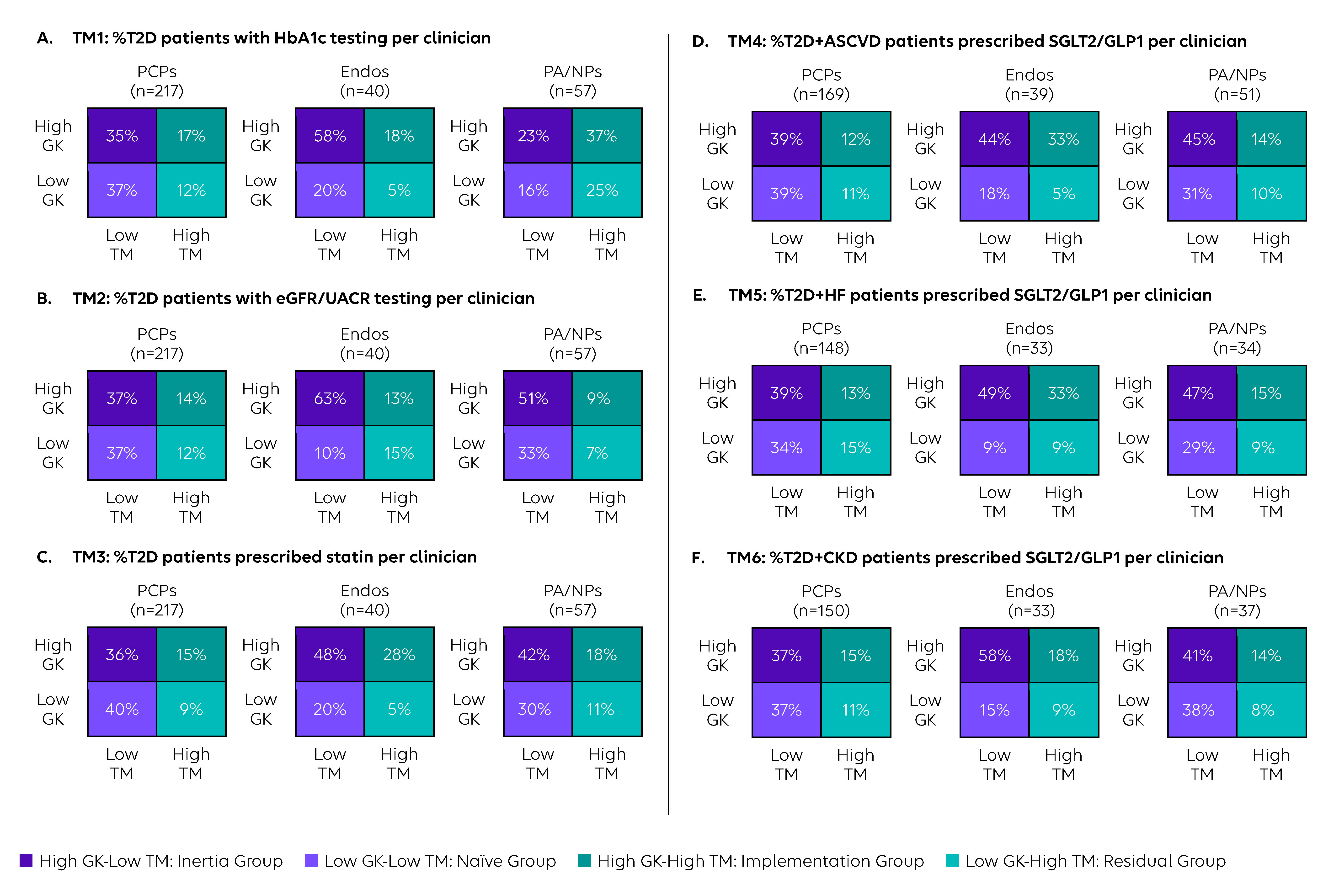
Key takeaways
Publication
Carelon Research project team: Judy Stephenson, Joseph Smith*, Vince Willey
*Carelon Research associate at the time of the study.
For more information on a specific study or to connect with the Actionable Insights Committee,
contact us at [email protected].
Sponsor: This study was conducted by Carelon Research, Inc., a subsidiary of Elevance Health, and funded by Boehringer Ingelheim.
The quote of "The greatest disparity was observed by geography, where members in the western region had the highest non-screening rate (44%)" was incorrectly cited in the original article and has been removed on 12/4/2024.
Lorem ipsum dolor sit amet, consectetur adipisicing elit, sed do eiusmod tempor incididunt ut labore et dolore magna aliqua. Ut enim ad minim veniam, quis nostrud exercitation ullamco laboris nisi ut.

"Et harum quidem rerum facilis est et expedita distinctio!"

"Nam libero tempore, cum soluta nobis est eligendi."

"Temporibus autem quibusdam et aut officiis debitis!"