
 New insights: Schizophrenia treatment and relapse patterns vary by payor type
 Medicaid patients with newly diagnosed schizophrenia or schizoaffective disorder appear to have higher relapse rates particularly compared to other payor types. Summary The Carelon Research team would also like to acknowledge significant contributions to this study from Keith Isenberg at Carelon Behavioral Health.
Enterprise Analytics Core domain(s): behavioral health
Background
Schizophrenia and schizoaffective disorder present an incremental burden to patients and payors through elevated healthcare resource utilization (HCRU) and costs. Given the unique composition and needs of patients with different types of insurance, quantifications of these burdens by payor type would be informative. However, there is a lack of such evidence.
Objective
To examine healthcare resource utilization (HCRU) and costs among patients with schizophrenia and schizoaffective disorder by relapse frequency.
Methods/Design
We identified patients aged 12-94 years with newly diagnosed schizophrenia or schizoaffective disorder (earliest diagnosis date was set as index date) between 01/01/2014 and 08/31/2020 with continuous enrollment for 12 months before (baseline) and after index date (follow-up) from the Healthcare Integrated Research Database (HIRD®).
We considered patients to have relapsed if they had either an emergency room visit claim with any diagnosis of a psychiatric condition, or an inpatient hospitalization claim with a primary diagnosis of schizophrenia or schizoaffective disorder during the 12-month follow-up period.
After stratifying by post-index relapse frequency (0, 1, or ≥2) and payor type (commercial, Medicare Advantage/Supplemental (Medigap)/Part D, or managed Medicaid), we examined patient characteristics, treatment patterns (including discontinuation, defined as failure to refill medication within 45 days of the depletion of the previous days’ supply), HCRU, costs, relapse patterns, and relapse predictors.
Results
We identified 4,974 commercially insured, 1,660 Medicare, and 4,858 Medicaid patients with newly diagnosed schizophrenia or schizoaffective disorder. During the 12-month follow-up period, 25% of commercial patients, 29% of Medicare patients, and 37% of Medicaid patients experienced relapse.
Relative to baseline, average all-cause follow-up costs increased by 105% for commercial patients, 66% for Medicare patients, and 77% for Medicaid patients. After adjusting for patient demographics, baseline comorbidities, and baseline utilization, more frequent relapse was associated with greater follow-up costs across all payor types (Figure 1).
Across all payor types, discontinuation of antipsychotic medications was frequent, especially among Medicaid patients. 58% of commercial patients, 40% of Medicare patients, and 65% of Medicaid patients discontinued their use of atypical antipsychotic medications during follow-up (Figure 2).
Compared to commercial patients, Medicare and Medicaid patients had approximately half as many psychotherapy visits during follow-up (an average of 12 vs. 5 vs. 7 visits, respectively).
Figure 1. Adjusted1 follow-up costs by relapse frequency and payor type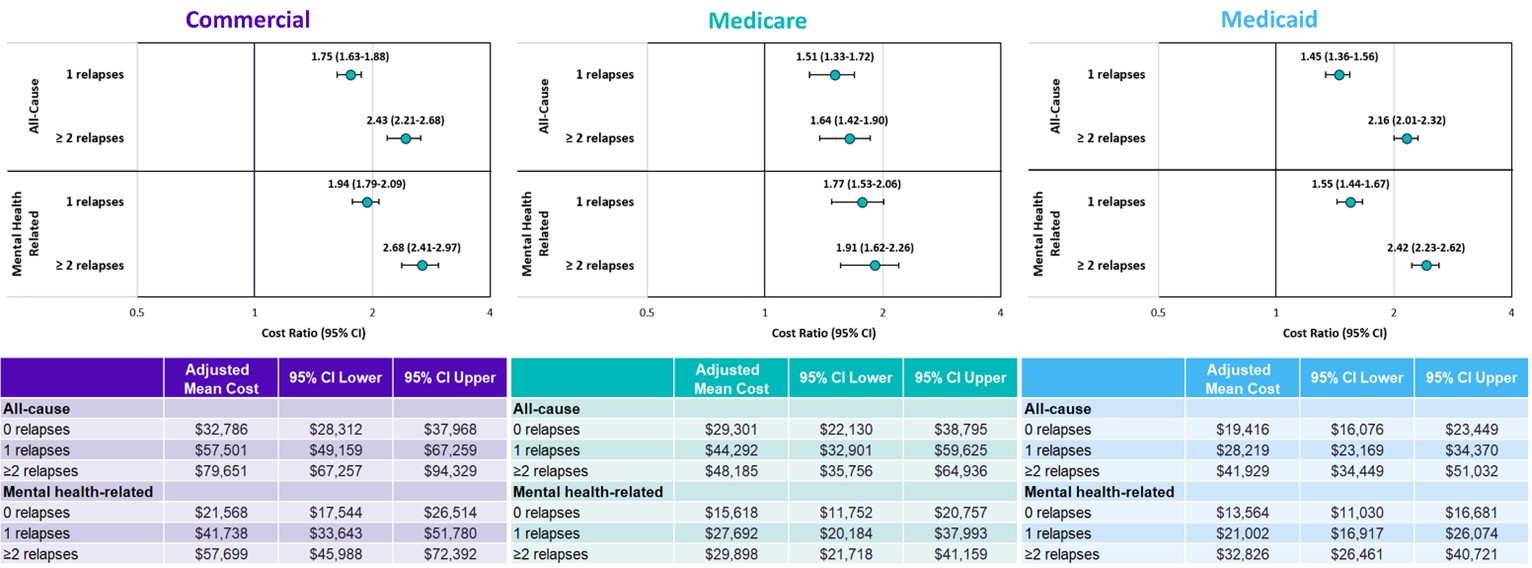
1Adjusted for patient demographics, baseline comorbidities, and baseline utilization.
Figure 2. Adjusted1 follow-up costs by relapse frequency and payor type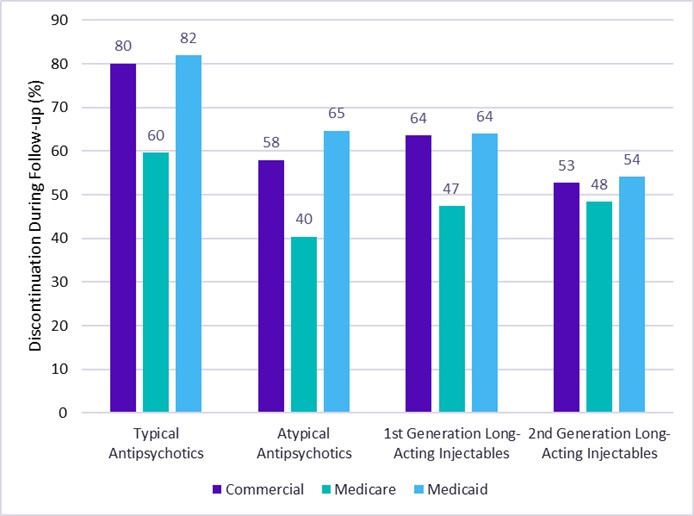
1Adjusted for patient demographics, baseline comorbidities, and baseline utilization.
Key takeaways
Publications
Carelon Research project team: Christopher L. Crowe (PI), Joseph L. Smith*, Lia N. Pizzicato*, Yiling Yang*, Chia-Chen Teng
For more information on a specific study or to connect with the Actionable Insights Committee,
contact us at [email protected].Sponsor: Funded by Boehringer Ingelheim Pharmaceuticals, Inc. and conducted as part of a collaboration with Elevance Health and Carelon Research.
Lorem ipsum dolor sit amet, consectetur adipisicing elit, sed do eiusmod tempor incididunt ut labore et dolore magna aliqua. Ut enim ad minim veniam, quis nostrud exercitation ullamco laboris nisi ut.

"Et harum quidem rerum facilis est et expedita distinctio!"

"Nam libero tempore, cum soluta nobis est eligendi."

"Temporibus autem quibusdam et aut officiis debitis!"