
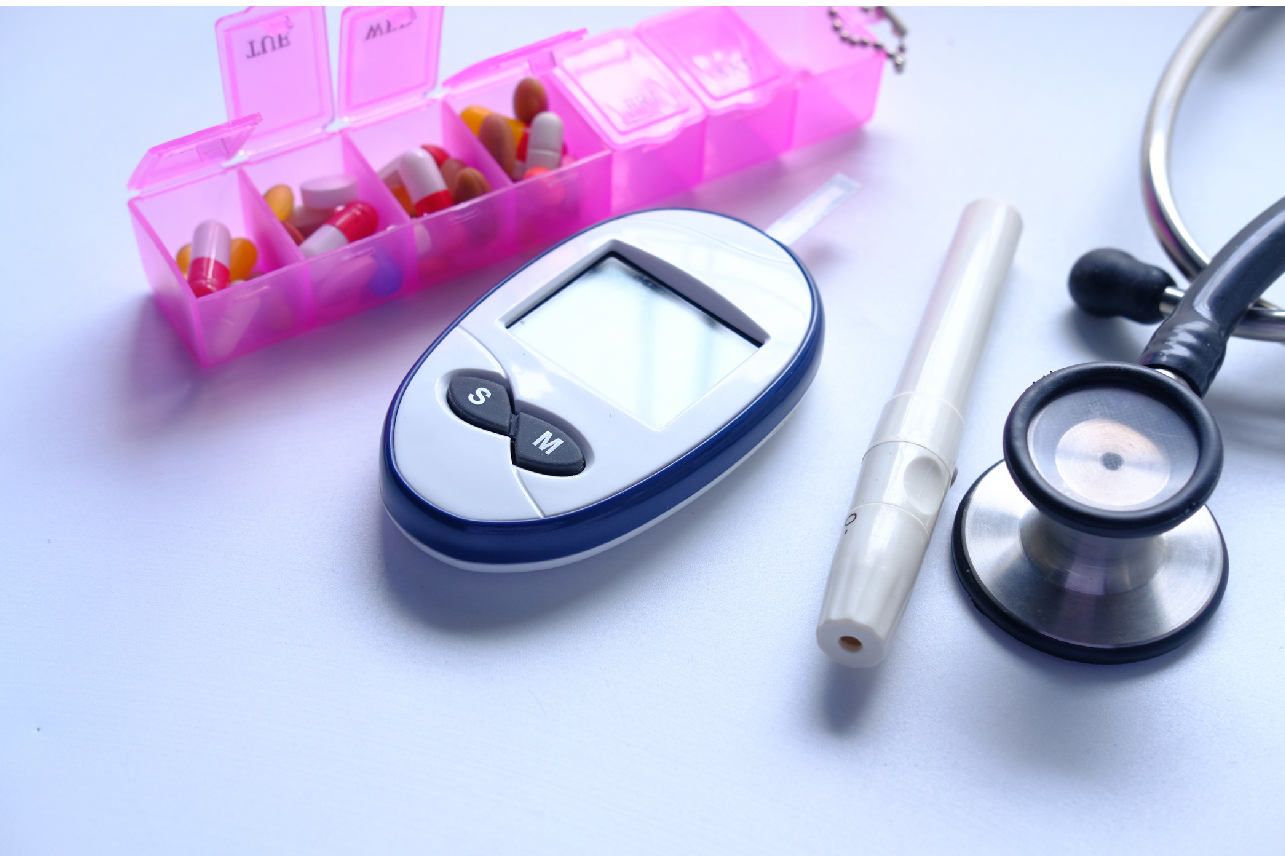
COVID T2D CVD Photo with spacers-01.jpgCOVID-19 is bad news for patients with type 2 diabetes mellitus (T2DM) and cardiovascular disease  (CVD)


COVID-19 patients with a combination of T2DM and CVD are at significantly greater risk of severe disease and even death compared to those without these underlying health conditions.

Enterprise Analytics Core domain(s): COVID-19, quality of care, CarelonRx


Summary

Background

The association between T2DM and severe COVID-19 outcomes has been reported, but data are scarce on the magnitude of the impact of pre-existing T2DM and concurrent CVD on COVID-19 outcomes. This study compared the clinical and economic outcomes among COVID-19 patients with pre-existing T2DM, T2DM+CVD, or neither.


Methods

A retrospective cohort study of COVID-19 patients identified from administrative and laboratory test result data. Propensity score matching and multivariable analyses were performed to control for the baseline differences between the study cohorts.


Results
  • The three cohorts (pre-existing T2DM, T2DM+CVD, or neither) had very different baseline demographic and clinical characteristics. COVID-19 patients with T2DM+CVD were significantly older and had more comorbid conditions such as hypertension, chronic obstructive pulmonary disease, and chronic kidney disease.
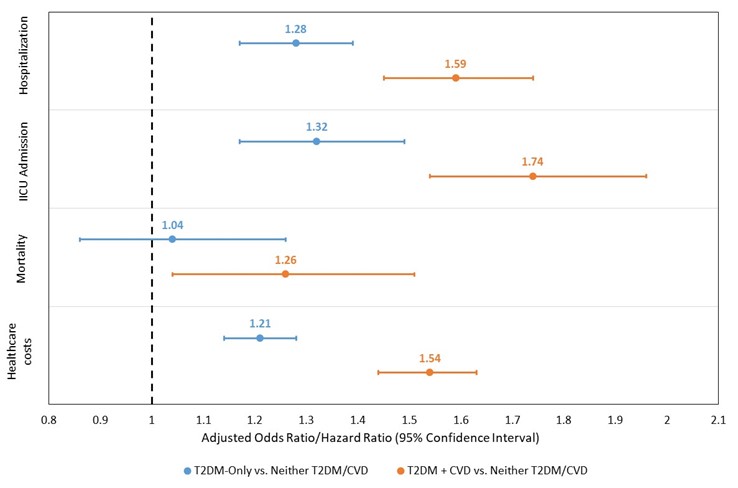
  • After balancing for key patient characteristics, COVID-19 patients with T2DM-only were 28% more likely to be hospitalized, 32% more likely to be admitted to the ICU, and incurred 21% greater healthcare costs than those with neither T2DM/CVD following COVID-19 infection. No significant increase in risk of mortality was seen in this comparison (Figure 1).
  • COVID-19 patients with T2DM+CVD were 59% more likely to be hospitalized, 74% more likely to be admitted to the ICU, incurred 54% greater healthcare costs, and had a 26% increased risk of mortality than COVID-19 patients with neither T2DM/CVD (Figure 1).

Figure 1. Adjusted hospitalization, ICU admission, mortality, and healthcare costs after COVID-19 infection

Figure 1. COVID T2D CVD.jpg


Key takeaways
  • COVID-19 patients with pre-existing T2DM+CVD and T2DM had significantly poorer clinical outcomes and higher costs of care than COVID-19 patients with neither T2DM/CVD, even after accounting for baseline differences between groups.
  • These findings support a more patient-centric, proactive triage and care management approach for T2DM patients with pre-existing CVD with COVID-19.


Publication

Poster presented at American Diabetes Association (ADA) 82nd Scientific Session, June 3-7, 2022, New Orleans, Louisiana.

Carelon Research project team: Christopher Crowe, Rachel Djaraher, Chi Nguyen, Rebecca Pepe, Vincent Willey


For more information on a specific study or to connect with the Actionable Insights Committee, contact us at [email protected].

This study was conducted by Carelon Research (formerly HealthCore, Inc.), a subsidiary of Elevance Health, and funded by Boehringer Ingelheim Pharmaceuticals with in-kind support from Elevance Health. Dissemination and sharing of the Newsletter is limited to Elevance Health and its subsidiaries and included findings and implications are for Elevance Health and its affiliates’ internal use only.


Ready to get started? Sign up now!

Highlighted Studies

A real-world study of immunoglobulin (IG) reveals multiple cost-saving opportunities 

Hub Domain(s): Immunology, oncology, costs of care, IngenioRx, policy guidance
Summary

  • Background: Immunoglobulins (IG) are costly blood-derived products accounting for more than $500m in annual spending in the Anthem membership
  • Methods: HealthCore examined IG utilization using claims data to evaluate appropriateness of use, the extent of site-of-care optimization and non-preferred IG use.
  • Results: The findings revealed significant off-label use of IGs (30%), including 22% for indications that were neither approved by FDA nor covered by Anthem, but were accepted by other health plans; and 8% for indications that were neither approved by FDA nor covered by any health plan
    • Additionally, 25% of the IG use was observed in the most expensive site of administration of hospital outpatient (HOPD) and non-preferred IG use accounted for 71% of the total IG use
  • Key Takeaways: Examining the IG uses from various dimensions presents several opportunities to IngenioRx and Anthem:
    • Reducing off-label IG use represented an estimated $27.8m annual savings opportunity
    • Shifting IG utilization from HOPD to a less expensive site of care could drive a further estimated $6.3m in annual savings
    • The study also identified opportunities to increase the share of preferred IG products used by our patients.


Major depressive disorder (MDD) patients highly impacted by COVID-19 face daunting challenges

Hub Domain(s): COVID, member experience
Summary

  • Background: Disruption to daily life and lockdown measures that were imposed in an attempt to contain the spread of COVID-19 presented new hurdles for at-risk populations, such as patients with major depressive disorder (MDD)
  • Methods: Conducted a 2020 internet survey to understand reasons for antidepressant continuation, switching and discontinuation in patients with MDD; COVID-19 pandemic questions were developed and added to survey.
    • COVID-19 Pandemic Impact (CPI) score was calculated and, based on their CPI scores, patients were categorized as experiencing low (LPI), medium (MPI) or high pandemic impact (HPI).
  • Results: Compared with LPI and MPI patients, HPI patients reported:
    • Significantly more problems accessing healthcare; few reported not having health insurance benefits due to loss of/reduced health insurance coverage (Figure 1).
    • More challenges obtaining depression prescription medications in terms of:
      • Filling new/current prescription(s)
      • Receiving samples from healthcare providers
      • Paying for prescription(s) due to loss of/reduced health insurance coverage and/or pharmacy benefits
    • Since start of COVID-19 pandemic engaged in significantly more:
      • Alcohol, drug, and tobacco use
      • Unhealthy mindless eating
      • Sedentary behavior
  • Key Takeaways: Our findings are consistent with literature showing that traumatic events, e.g. pandemics, can negatively impact health behaviors.
    • More research is needed to explore the COVID-19 impact in other patient populations.
    • Education opportunities exist for health plans to increase awareness among providers and patients of possible short and long-term COVID-19 effects on health behaviors.

Figure 1: Impact of COVID-19 pandemic on accessing healthcare/mental healthcare
  • Publications: Poster presented at the Virtual American Society of Clinical Psychopharmacology (ASCP) Annual Meeting, June 1-4, 2021

Despite lower healthcare resource utilization and better HbA1c outcomes, compared to…

Young men ages 18 to 25 are at greater risk of developing myocarditis/pericarditis…

Consectetur adipiscing elit...

Joanna C.

"Et harum quidem rerum facilis est et expedita distinctio!"

Stanley T.

"Nam libero tempore, cum soluta nobis est eligendi."

Danielle W.

"Temporibus autem quibusdam et aut officiis debitis!"

Teams at Carelon Research