

 Risk of myocarditis and pericarditis following the COVID-19 mRNA vaccination: comparing mRNA-1273 (Moderna) and BNT162b2 (Pfizer)
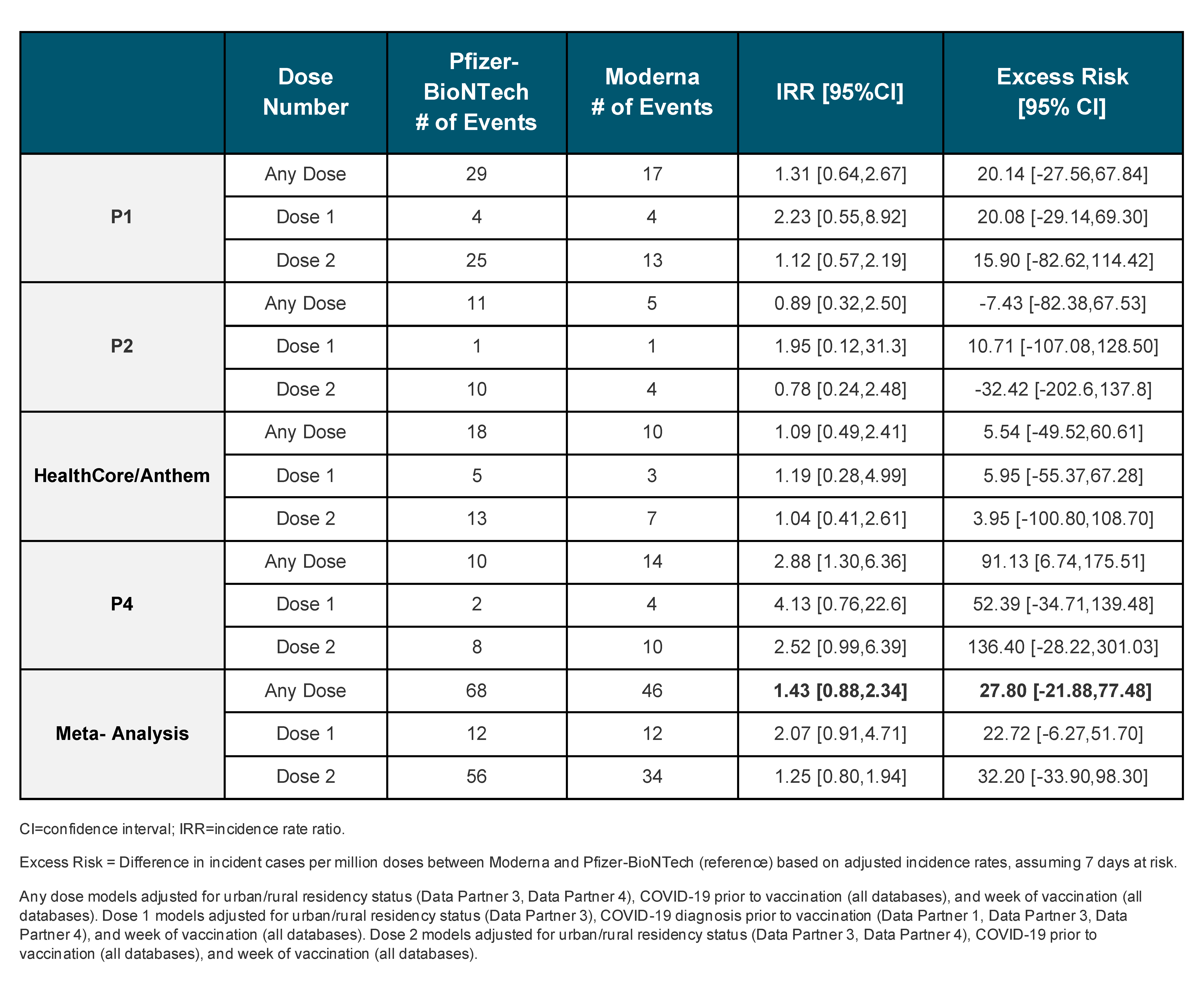
 Enterprise Analytics Core domain(s): Vaccines, COVID-19, policy guidance Summary In spring/summer 2021, a potential association of myocarditis and/or pericarditis with COVID-19 mRNA vaccines was reported. Preliminary prior research1 suggested a higher risk of myocarditis, an inflammation of the heart muscle, after receiving the mRNA-1273 (Moderna) than the BNT162b2 (Pfizer) vaccine. Due to risk of myocarditis, use of the Moderna vaccine in people 30 years of age or younger was paused in some European countries. This study compared the rates of myocarditis/pericarditis between patients receiving the two mRNA vaccines. This observational multi-database cohort study, conducted between December 2020 and November 2021, used claims data to identify COVID-19 mRNA vaccination among those aged 18-64. The primary outcome of myocarditis/pericarditis was identified using International Classification of Diseases, Tenth Revision, and Clinical Modification (ICD-10-CM) diagnosis codes. New myocarditis/pericarditis events were included if they occurred 1–7 days following mRNA vaccination. Multivariable Poisson regression estimated the adjusted brand-specific incidence rates (IR) and incidence rate ratios (IRRs). Expected background rates of myocarditis/pericarditis were estimated from cohorts from calendar year 2019. There was a higher rate of myocarditis/pericarditis among younger males (18-25) after each mRNA vaccination brand compared to rates of the disease prior to COVID-19. The occurrence was rare, but highest in males aged 18-25 after the second dose (IR=1.71 per 100,000 person-days). Comparing the two brands, the incidence of myocarditis/pericarditis was similar in Elevance Health affiliated health plan insured members (adjusted IRR=1.09, 95%CI=0.49-2.41). However, when combined with three other insurance providers, the risk of myocarditis/pericarditis was 43% higher after Moderna compared to Pfizer vaccination ((adjusted IRR=1.43, 95%CI=0.88, 2.34); excess risk = 27.80 per million doses, 95%CI= -21.88, 77.48). Direct head-to-head comparison of Moderna and Pfizer-BioNTech, incidence rate ratios (IRRs) for myocarditis/pericarditis following 1–7 days of vaccination, for males aged 18–25 years by brand, dose number, and database Wong HL, Hu M, Zhou CK, et al. Risk of myocarditis and pericarditis after the COVID-19 mRNA vaccination in the USA: a cohort study in claims databases. Lancet. 2022; 399: 2191–99. Carelon Research project team: Ramya Avula, Daniel Beachler, Shiva Chaudhary, Brian Greenwald, Navyatha Namburu, Ramin Riahi, Priyanka Sagare, Grace Stockbower, Shiva Vojjala This study was conducted by Carelon Research (formerly HealthCore, Inc.), a subsidiary of Elevance Health, and funded by the Food & Drug Administration (FDA). Dissemination and sharing of the Newsletter is limited to Elevance Health and its subsidiaries and included findings and implications are for Elevance Health and its affiliates’ internal use only.
Young men ages 18 to 25 are at greater risk of developing myocarditis/pericarditis following two mRNA vaccines, though the overall risk appears low and fairly similar across the two vaccine types.
Background
Methods
Results
Key takeaways
1ME Oster, DK Shay, JR Su, et al. Myocarditis cases reported after mRNA-based COVID-19 vaccination in the US from December 2020 to August 2021. JAMA, 327 (2022), pp. 331-340.
Publication
For more information on a specific study or to connect with the Actionable Insights Committee, contact us at [email protected].
Hub Domain(s): Immunology, oncology, costs of care, IngenioRx, policy guidance
Summary:
Hub Domain(s): COVID, member experience
Summary:
Figure 1: Impact of COVID-19 pandemic on accessing healthcare/mental healthcare

COVID-19 patients with a combination of T2DM and CVD…
Despite lower healthcare resource utilization and better HbA1c outcomes, compared to…

Varying scoring systems used for measuring pediatric heart development make it…
"Et harum quidem rerum facilis est et expedita distinctio!"

"Nam libero tempore, cum soluta nobis est eligendi."

"Temporibus autem quibusdam et aut officiis debitis!"