
 Study provides compelling evidence of best treatment option for patients with chronic limb-threatening ischemia
Results from an international, randomized controlled trial provide some of the first published evidence comparing two common options. Enterprise Analytics Core domain(s): Cardiometabolic, quality of care, policy guidance Summary The use of these two different treatments for CTLI varies greatly among providers and is based on several patient and physician factors. There exists little to no published evidence comparing the two treatment options. Key takeaways *Carelon Research associate at the time of the study.
Background
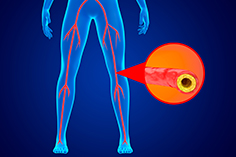
Peripheral artery disease is a condition that affects 200 million people worldwide (Fowkes, 2013). Eleven percent of people with peripheral artery disease have the most severe type, called chronic limb-threatening ischemia (CLTI), a medical condition where the foot is not receiving enough blood flow. CLTI causes foot pain, ulcers, and gangrene, and can result in the need for foot amputation.
A procedure called “revascularization” is used to try to improve blood flow to the leg and foot and avoid the need for amputation. There are two types of revascularizations:
Objective
This study aimed to compare outcomes between both treatments for CTLI.
Methods
The BEST-CLI trial was an international randomized trial that enrolled eligible participants from 2014-2019 at 150 study sites in the United States, Canada, Finland, Italy, and New Zealand. Participants were split into two groups based on whether the saphenous vein in their leg could be used for revascularization. Within the two groups, participants were randomized to the surgical treatment arm or the endovascular treatment arm. Participants were followed for up to 7 years after the trial and information about any major limb event, such as amputation or the need for another treatment for CTLI, was collected.
Results
Figure 1. Kaplan-Meier curves of the primary outcome and its components in Cohort 1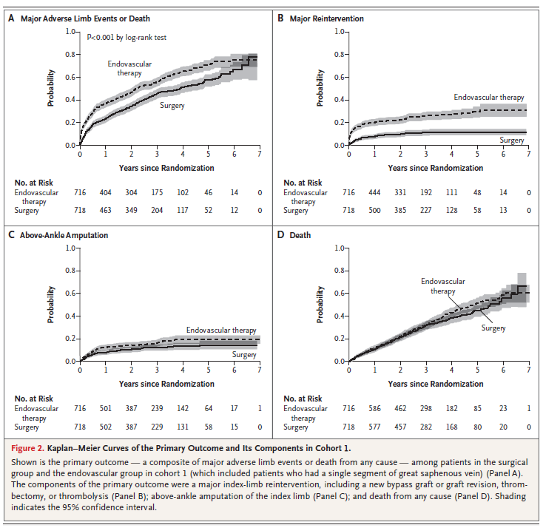
Publication(s)
Carelon Research project team: Mark Cziraky, F. Sandra Siami*, Taye Hamza*, Susan Assmann*, Michelle McKean*, Max van Over
For more information on a specific study or to connect with the Actionable Insights Committee,
contact us at [email protected].Carelon Research, Inc., a subsidiary of Elevance Health, serves as the Data Coordinating Center for this study. This study was funded by the National Heart, Lung, and Blood Institute. Dissemination and sharing of the Newsletter is limited to Elevance Health and its subsidiaries and included findings and implications are for Elevance Health and its affiliates’ internal use only.
Lorem ipsum dolor sit amet, consectetur adipisicing elit, sed do eiusmod tempor incididunt ut labore et dolore magna aliqua. Ut enim ad minim veniam, quis nostrud exercitation ullamco laboris nisi ut.

"Et harum quidem rerum facilis est et expedita distinctio!"

"Nam libero tempore, cum soluta nobis est eligendi."

"Temporibus autem quibusdam et aut officiis debitis!"