
 Adherence to diabetes medications has significant clinical and economic advantages
For patients with type 2 diabetes, adherence to any non-insulin diabetes medication can help to reduce the risk of death and hospitalization. Adherence to dual therapy may also result in total cost savings. Enterprise Analytics Core domain(s): Cardiometabolic, cost of care, quality of care, HEDIS/STARS Summary iCenters for Disease Control and Prevention. Diabetes. U.S. Department of Health & Human Services. https://www.cdc.gov/nchs/fastats/diabetes.htm. Published 2022. Updated 25 January 2023. iiGuerci B, Chanan N, Kaur S, Jasso-Mosqueda JG, Lew E. Lack of Treatment Persistence and Treatment Nonadherence as Barriers to Glycaemic Control in Patients with Type 2 Diabetes. Diabetes Ther. 2019;10(2):437-449.
Background
Uncontrolled type 2 diabetes mellitus (T2D) increases overall patient morbidity and mortality and significantly increases cost of care burden to the healthcare system in the US. Although research suggests that diabetes medication adherence remains low, there is limited real-world evidence evaluating the causal link between adherence to these treatments and health outcomes and cost of care.
Objective
To assess the causal impact of adherence to any non-insulin diabetes medication and any non-insulin dual therapy on health outcomes and cost of care.
Methods
Carelon Research analyzed data from commercial and Medicare insured Elevance Health members with T2D and integrated medical and pharmacy benefits. Medication adherence to the different regimens was calculated using proportion of days covered (PDC), and PDC was regarded as adherent when it was greater than or equal to 80 percent. Robust causal inference methods, known as marginal structural models, were used to account for the time-varying nature of adherence and control for other factors when evaluating the causal impact of adherence on health outcomes and cost of care.
Results
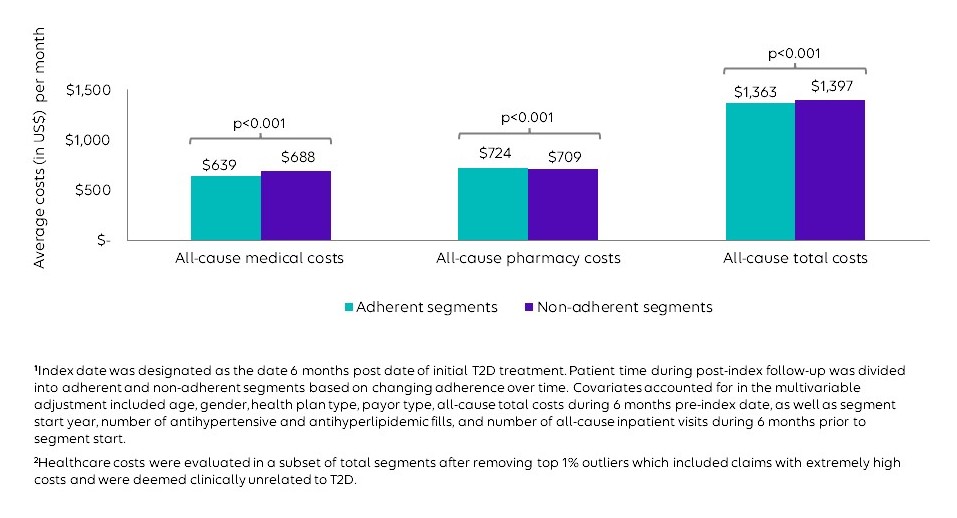
Of 473,438 T2D patients receiving diabetes medication, 23% received dual therapy. Of these patients, about one fifth received metformin in combination with an SGLT-2 inhibitor or GLP-1 inhibitor. After balancing differences in adherent and non-adherent groups, the impact of adherence to any diabetes medication and to dual therapy on health outcomes followed similar trends. However, adherence to dual therapy was more impactful and led to reduced total costs. Compared to non-adherence to dual therapy, adherence for at least eight months resulted in:
Figure 1. Adjusted healthcare costs per month between cohorts adherent vs non-adherent to dual non-insulin antidiabetic therapy1,2
Key takeaways
Carelon Research project team: Nicole Thomas, Shivani Pandya*, Hiangkiat (Jason) Tan, Vincent J. Willey, Chia-Chen (Jenny) Teng, Zhengzheng Jiang*, Megan Reidy, Aaron Haynes
The team at Carelon Research would also like to acknowledge significant contributions to this study from Chelsea Day and A.J. Davis^ at CarelonRx.
*At Carelon Research at the time of this study
^At CarelonRx at the time of this study
For more information on a specific study or to connect with the Actionable Insights Committee, contact us at [email protected].This study was conducted by Carelon Research, Inc. (formerly HealthCore, Inc.), a subsidiary of Elevance Health, in collaboration with CarelonRx, and sharing of the Newsletter is limited to Elevance Health and its subsidiaries and included findings and implications are for Elevance Health and its affiliates’ internal use only.
Lorem ipsum dolor sit amet, consectetur adipisicing elit, sed do eiusmod tempor incididunt ut labore et dolore magna aliqua. Ut enim ad minim veniam, quis nostrud exercitation ullamco laboris nisi ut.

"Et harum quidem rerum facilis est et expedita distinctio!"

"Nam libero tempore, cum soluta nobis est eligendi."

"Temporibus autem quibusdam et aut officiis debitis!"