 "No treatment” can be more costly than “any treatment” for patients with depression
Enabling faster access to psychotherapy, including via telehealth, is one possible solution to improving symptoms while generating cost savings. Enterprise Analytics Core domain(s): Behavioral health, health equity/social determinants of health, cost of care, quality of care Summary Key takeaways *Carelon Research associate at the time of the study.
Background
In the US, depression is one of the most prevalent mental health disorders, with a lifetime risk of 30% (Kessler 2012). Few studies have examined the use of nonpharmacologic treatments, or treatments that do not involve medications, and their association with healthcare resource utilization (HCRU) and cost.
Objective
To describe prevalence and associations between patient/provider characteristics and treatment type, and characterize HCRU and cost by treatment type, for patients with newly diagnosed major depressive disorder.
Methods
This retrospective, observational study used claims data to examine commercially insured US patients aged 18-62 years with newly diagnosed depression between January 2017 and September 2019. Patients with other diagnosed mental health disorders were excluded. We observed patients for two years after their initial diagnosis, described their demographic and clinical characteristics, treatment patterns, and costs, and estimated associations between patient characteristics and selected outcomes.
Results
Figure 1. All-cause average monthly costs among patients with MDD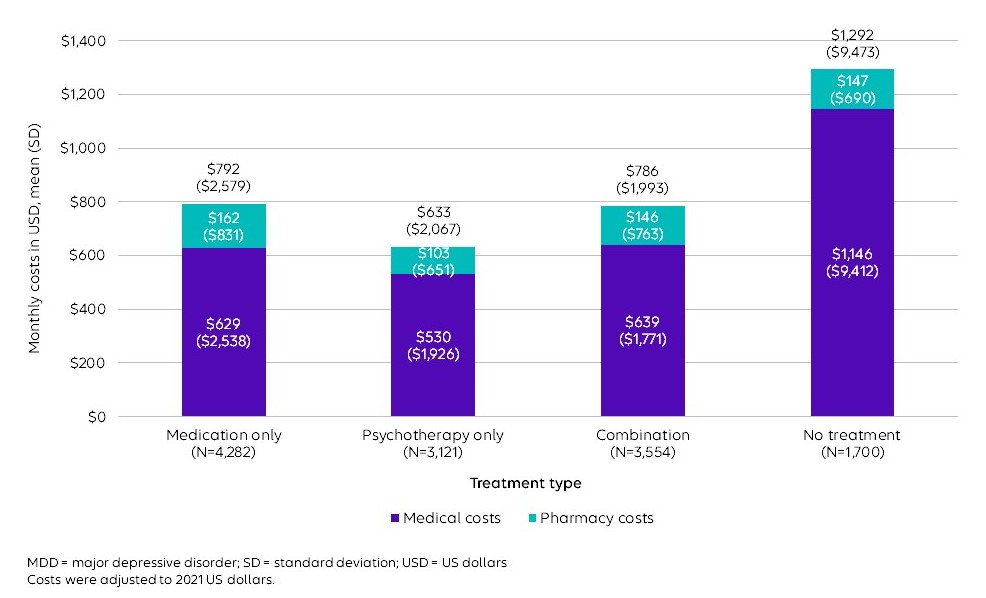
Publication(s)
Resources
Carelon Research project team: Lia Pizzicato*, Yiling Yang*, Claire Bocage, Michael Grabner
For more information on a specific study or to connect with the Actionable Insights Committee,
contact us at [email protected].This study was conducted by Carelon Research, Inc., a subsidiary of Elevance Health, and funded by the Innovation and Value Initiative. Dissemination and sharing of the Newsletter is limited to Elevance Health and its subsidiaries and included findings and implications are for Elevance Health and its affiliates’ internal use only.
Lorem ipsum dolor sit amet, consectetur adipisicing elit, sed do eiusmod tempor incididunt ut labore et dolore magna aliqua. Ut enim ad minim veniam, quis nostrud exercitation ullamco laboris nisi ut.

"Et harum quidem rerum facilis est et expedita distinctio!"

"Nam libero tempore, cum soluta nobis est eligendi."

"Temporibus autem quibusdam et aut officiis debitis!"