
AINLipid-study-photoStudy highlights opportunity to reduce risk of adverse cardiovascular events among patients with atherosclerotic cardiovascular disease

A little lipids testing, and guideline-directed therapy compliance, can go a long way for people with atherosclerotic cardiovascular disease.

Enterprise Analytics Core domain(s): Cardiometabolic


Summary

Background
The American Heart Association/American College of Cardiology (AHA/ACC) recommends individuals with atherosclerotic cardiovascular disease (ASCVD), receive periodic low density lipoprotein cholesterol (LDL-C) monitoring and guideline-directed treatment (GDT) to reduce the risk of cardiovascular events, such as heart attack and stroke. Treatments include statin therapy, a class of cholesterol-lowering medications, and proprotein convertase subtilisin/kexin type 9 inhibitor (PCSK9i) therapy, a new class of drugs that lower LDL-C from blood circulation.

According to the guidelines:

  • Patients with ASCVD should receive high-intensity statin therapy or maximally tolerated statin therapy.
  • Patients with type 2 diabetes mellitus (T2DM) should receive moderate or high-intensity statin therapy.
  • Patients with high-risk ASCVD on maximally tolerated statin and ezetimibe whose LDL-C level remains ≥70 mg/dL, add PCSK9i therapy.


Objective

  • Assess the rate of AHA/ACC guideline compliance with appropriate utilization of statins and PCSK9i therapy.
  • Assess rates of LDL-C testing and LDL-C goal attainment (LDL-C<70 mg/dL).


Methods

This retrospective study used claims from the Healthcare Integrated Research Database (HIRD®) to identify ASCVD/T2DM patients 18 years or older with commercial or Medicare Advantage insurance initiating statins or PCSK9i between 1/1/2019 and 12/31/2020.

We evaluated:
  • GDT compliance at the time of initiation of statin or PCSK9i
  • LDL-C testing in the 1-year period before/after treatment initiation
  • LDL-C goal attainment (LDL-C<70 mg/dL) in the 1-year period after initiating statins or PCSK9i

Results

  • In total, 38,000 patients with ASCVD and 33,581 patients with T2DM without prior ASCVD initiated statin, and 3,038 patients with ASCVD initiated PCSK9i (mean age: 61-65 years; males: 55-60%).
  • GDT compliance was as follows:
    • 51% among patients with ASCVD initiating statins.
    • 91% among patients with T2DM (without prior ASCVD) initiating statins.
    • 42% among patients with ASCVD initiating PCSK9i.
  • The extent of LDL-C testing was as follows:
    • 69% before initiating a statin and 67% after initiation among ASCVD/T2DM patients on statins.
    • 76% before initiating a PCSK9i and 72% after initiation among ASCVD patients on PCSK9i.
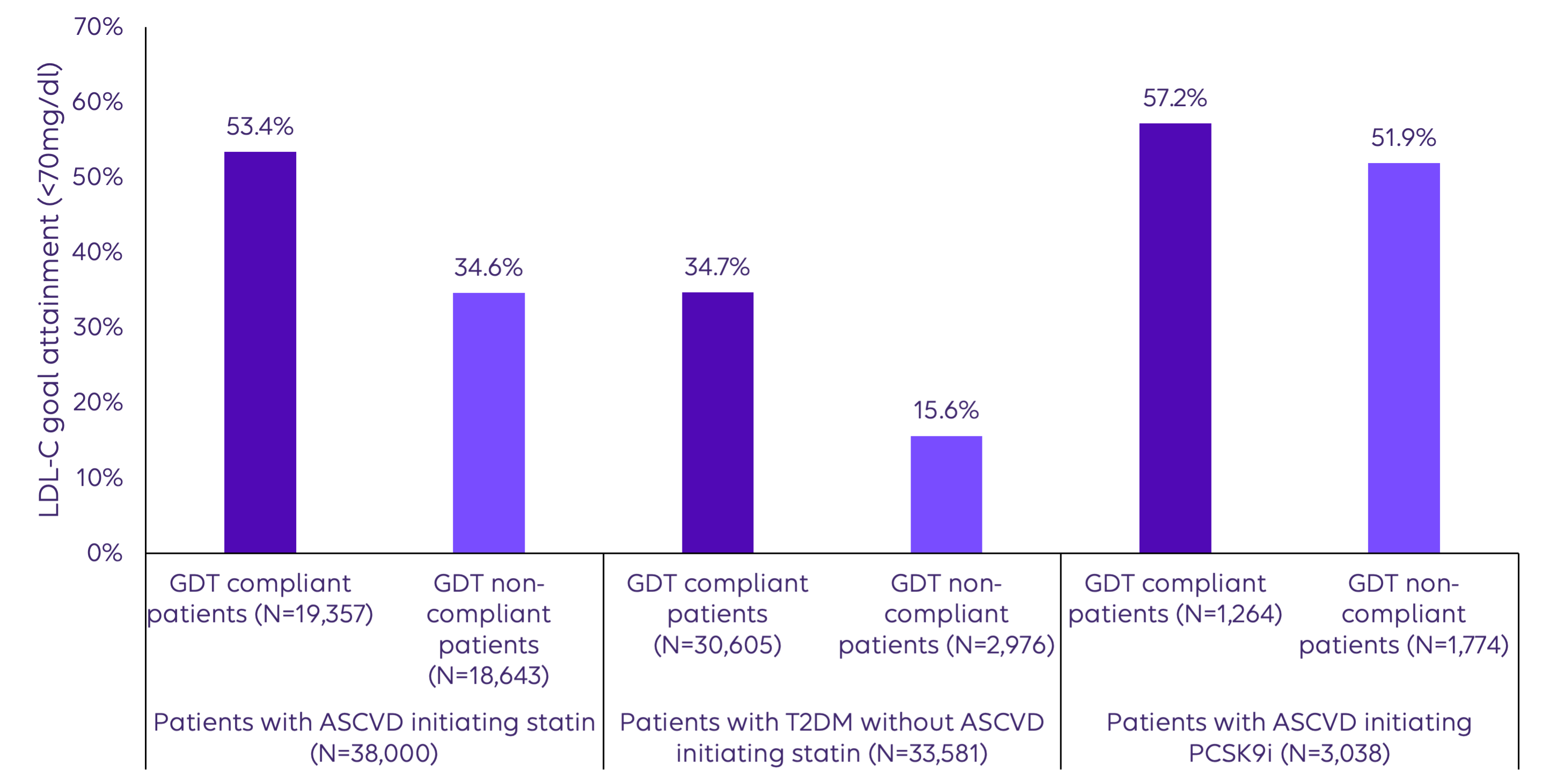
  • Among a subset of patients with LDL-C values, attainment of the LDL-C treatment goal (LDL-C<70 mg/dL) was higher among GDT compliant patients vs GDT non-compliant patients (Figure 1).

Figure 1. LDL-C <70 mg/dL attainment among GDT compliant patients vs GDT non-compliant patients

Figure 1

Key takeaways
  • GDT compliance for statin and PCSK9i among patients with ASCVD is non-optimal.
  • LDL-C testing was not ordered in 25-30% of patients with ASCVD before and after initiating statins or PCSK9i. Targeted initiatives such as clinical programs to increase periodic LDL-C monitoring may promote GDT compliance.
  • Achievement of LDL-C goals was improved with GDT compliance, but there is opportunity to raise awareness/compliance to GDT and periodic LDL-C monitoring.
  • The integration of LDL-C laboratory data with medical and pharmacy claims in this study enabled deeper insight into hyperlipidemia treatment and outcomes within our membership. The information may be further utilized to identify cohorts of patients and providers for interventions.

Carelon Research project team: Shivani Pandya*, Nilesh Gangan, Eric Stanek, Mark Cziraky
*Carelon Research associate at the time of the study.


For more information on a specific study or to connect with the Actionable Insights Committee,
contact us at [email protected].

This study was conducted by Carelon Research, Inc., a subsidiary of Elevance Health, in collaboration with CarelonRx. Dissemination and sharing of the Newsletter is limited to Elevance Health and its subsidiaries and included findings and implications are for Elevance Health and its affiliates’ internal use only.

Ready to get started? Sign up now!

Lorem ipsum dolor sit amet

2-Col, Right Image

Lorem ipsum dolor sit amet, consectetur adipisicing elit, sed do eiusmod tempor incididunt ut labore et dolore magna aliqua. Ut enim ad minim veniam, quis nostrud exercitation ullamco laboris nisi ut.

Lorem ipsum dolor sit amet, consectetur adipisicing, sed do eiusmod tempor incididunt ut labore et dolore magna aliqua. Ut enim ad minim veniam, quis nostrud exercitation ullamco laboris nisi ut. Ut ad minim veniam.

Vestibulum ante ipsum primis in faucibus orci luctus etel ultrices posuere cubilia Curae.

2-Col, Left Image

Lorem ipsum dolor sit amet, consectetur adipisicing elit, sed do eiusmod tempor incididunt ut labore et dolore magna aliqua. Ut enim ad minim veniam, quis nostrud exercitation ullamco laboris nisi ut.

  • Many addon features
  • Fully responsive & adaptive
  • SEO optimized
  • Attractive with a modern touch
  • Full Support

Ut Enim Minima

Sed ut perspiciatis unde omnis iste natus error sit voluptatem!

Quis Autem Vel

Nemo enim ipsam voluptatem quia voluptas sit odit aut fugit!

Quo Voluptas

Ut enim ad minima veniam, quis nostrum exercitationem ullam!

Consectetur adipiscing elit...

Joanna C.

"Et harum quidem rerum facilis est et expedita distinctio!"

Stanley T.

"Nam libero tempore, cum soluta nobis est eligendi."

Danielle W.

"Temporibus autem quibusdam et aut officiis debitis!"
Teams at Carelon Research