
 The COVID-19 pandemic isn't over for everyone: the silent burden for the immunocompromised
 Please be advised that the study results are confidential and cannot be shared outside the Elevance Health organization as they are currently under consideration for publication. Though COVID-19 has become less severe for most people since the end of the pandemic, immunocompromised patients suffer from higher infection rates and a disproportionate health and economic burden. Summary Key takeaways
Enterprise Analytics Core domain(s): Health equity/SDoH, cost of care, quality of care
Background
The end of the public health emergency, availability of vaccines and treatments, and general “COVID fatigue” have led to general sentiment that the morbidity and mortality associated with COVID-19 is a thing of the past. However, individuals who are immunocompromised (IC) or on an immunosuppressive treatment (IST) may still be at significant risk for poor health outcomes associated with COVID-19.
Objective
To estimate COVID-19 incidence rate and severity for an immunocompromised population and describe COVID-19-related healthcare resource utilization (HCRU) and costs.
Methods
Results
Figure 1. The post-index incidence rate of COVID-19 per 1,000 patient-years (April 1, 2020–December 31, 2022)
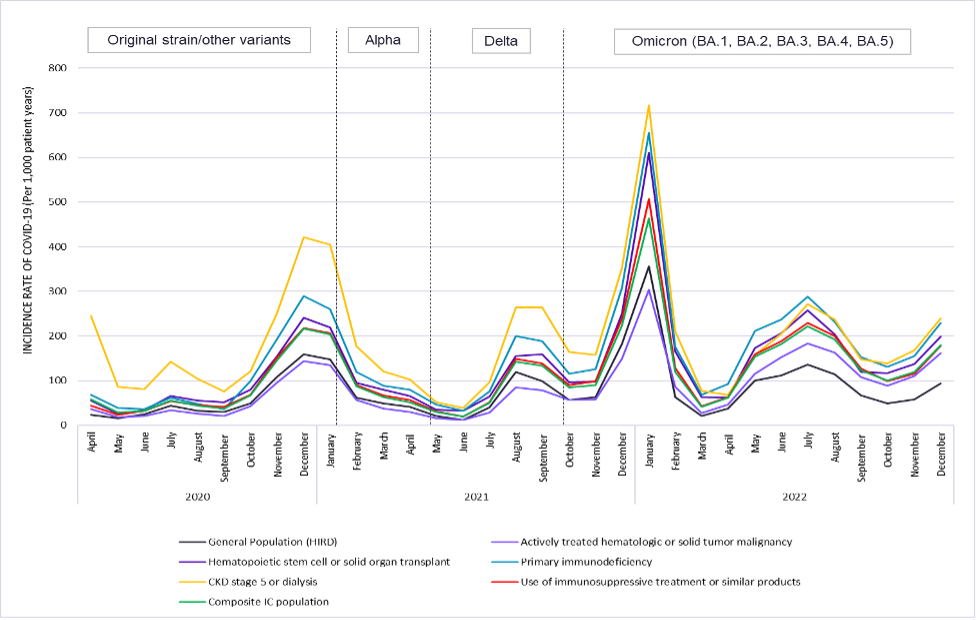 *The index date was defined as day 366 of continuous enrollment for the HSP, and the first diagnosis for IC or fill date for IST, or 4/1/2020, (whichever came last) for the IC cohort. Members were followed until disenrollment in the health plan, study end date, or death, whichever came first.
Publications
References
Carelon Research project team: Cachet Wenziger, Chia-Chen Teng, Claire Bocage, Cristian Rojas-Lazic, Ramya Avula, Dianna Hayden, Elizabeth Marks, Vince Willey, Amita Ketkar, Spencer Bard*, Amanda Neikirk*, Rebecca Pepe*, Lia Pizzicato*
*Carelon Research associate at the time of the study.
For more information on a specific study or to connect with the Actionable Insights Committee,
contact us at [email protected].
This study was conducted by Carelon Research, Inc., a subsidiary of Elevance Health, and funded by AstraZeneca. Dissemination and sharing of the Newsletter is limited to Elevance Health and its subsidiaries, and included findings and implications are for Elevance Health and its affiliates’ internal use only.
Lorem ipsum dolor sit amet, consectetur adipisicing elit, sed do eiusmod tempor incididunt ut labore et dolore magna aliqua. Ut enim ad minim veniam, quis nostrud exercitation ullamco laboris nisi ut.
Lorem ipsum dolor sit amet, consectetur adipisicing, sed do eiusmod tempor incididunt ut labore et dolore magna aliqua. Ut enim ad minim veniam, quis nostrud exercitation ullamco laboris nisi ut. Ut ad minim veniam.
Vestibulum ante ipsum primis in faucibus orci luctus etel ultrices posuere cubilia Curae.
Lorem ipsum dolor sit amet, consectetur adipisicing elit, sed do eiusmod tempor incididunt ut labore et dolore magna aliqua. Ut enim ad minim veniam, quis nostrud exercitation ullamco laboris nisi ut.

Sed ut perspiciatis unde omnis iste natus error sit voluptatem!

Nemo enim ipsam voluptatem quia voluptas sit odit aut fugit!

Ut enim ad minima veniam, quis nostrum exercitationem ullam!

"Et harum quidem rerum facilis est et expedita distinctio!"

"Nam libero tempore, cum soluta nobis est eligendi."

"Temporibus autem quibusdam et aut officiis debitis!"