
 Patients newly diagnosed with COPD face significant risk of death and cardiovascular events following moderate and severe exacerbations
 In one of the first real-world studies of newly diagnosed COPD patients, researchers found an increased risk of death and cardiovascular events that persisted for up to two years following moderate and severe exacerbations and increased with each subsequent exacerbation. Summary Key takeaways
Enterprise Analytics Core domain(s): Cardiometabolic, community health (SDoH), policy guidance
Background
Acute exacerbations of chronic obstructive pulmonary disease (AECOPD) are episodes where COPD symptoms quickly and significantly worsen. Patients often need medical care and additional treatment to manage AECOPD.
Objective
To estimate the magnitude and duration of risk of cardiovascular events and death following AECOPD, and whether risks varied by number and severity of exacerbation in commercially insured Americans.
Methods
This was a retrospective cohort study of newly diagnosed COPD patients ≥40 years old in the Healthcare Integrated Research Database from 2012-2019. Patients experiencing exacerbations at any point on or after their COPD diagnosis comprised the “exacerbation cohort.” Patients without a history of exacerbations comprised the “unexposed” cohort. Moderate exacerbations were outpatient visits with an antibiotic or glucocorticoid fill; severe exacerbations were emergency department visits or hospitalizations for AECOPD.
The risks of a cardiovascular event or death (defined using data linked from the National Death Index) following an exacerbation were estimated adjusting for medical and prescription history and stratified by follow-up time, type of cardiovascular event, exacerbation severity, rank of exacerbation (first, second, or third), urbanicity, and neighborhood socioeconomic status (SES).
Results
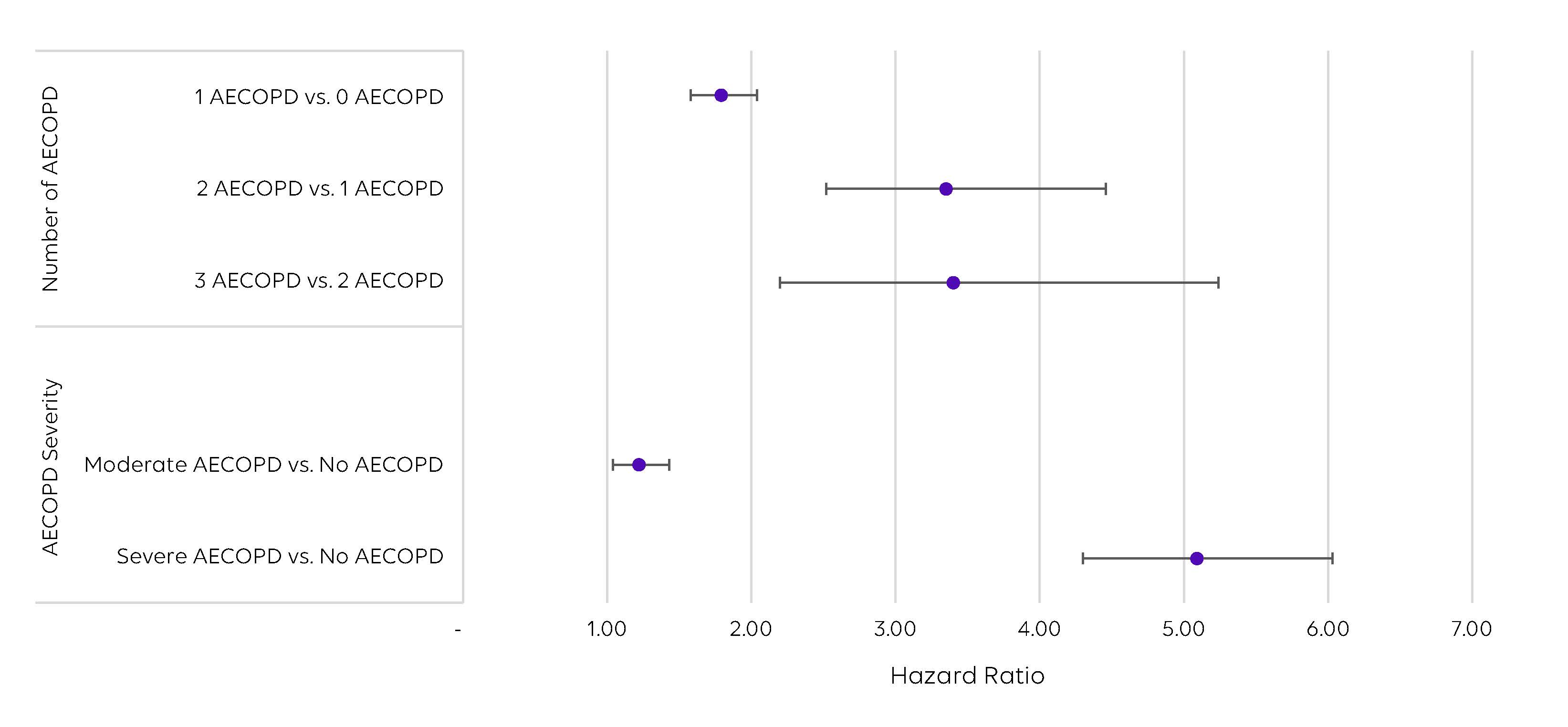
Among 435,925 patients, 170,236 experienced ≥1 exacerbation. Risk of death was elevated for 2 years (Figure 1) and was highest in the first 30 days following an exacerbation (any exacerbation hazard ratio (HR)=1.79, 95% confidence interval (C)I=1.58—2.04; moderate HR=1.22, 95% CI=1.04—1.43; severe HR=5.09, 95% CI=4.30—6.03) (Figure 2).
Risks of cardiovascular events were increased for 1 year following an AECOPD and were highest in the first 30-days (any exacerbation HR=1.34, 95% CI=1.23—1.46; moderate HR=1.23 (95% CI 1.12—1.35); severe HR=1.93 (95% CI= 1.67—2.22).
Each subsequent AECOPD was associated with incrementally higher rates of both death and cardiovascular events (Figure 2). Patients living in rural neighborhoods and lower SES neighborhoods were at higher risk of a cardiovascular event and death following an exacerbation.
Figure 1. Hazard ratios (95% CI) of death and acute CV events following AECOPD
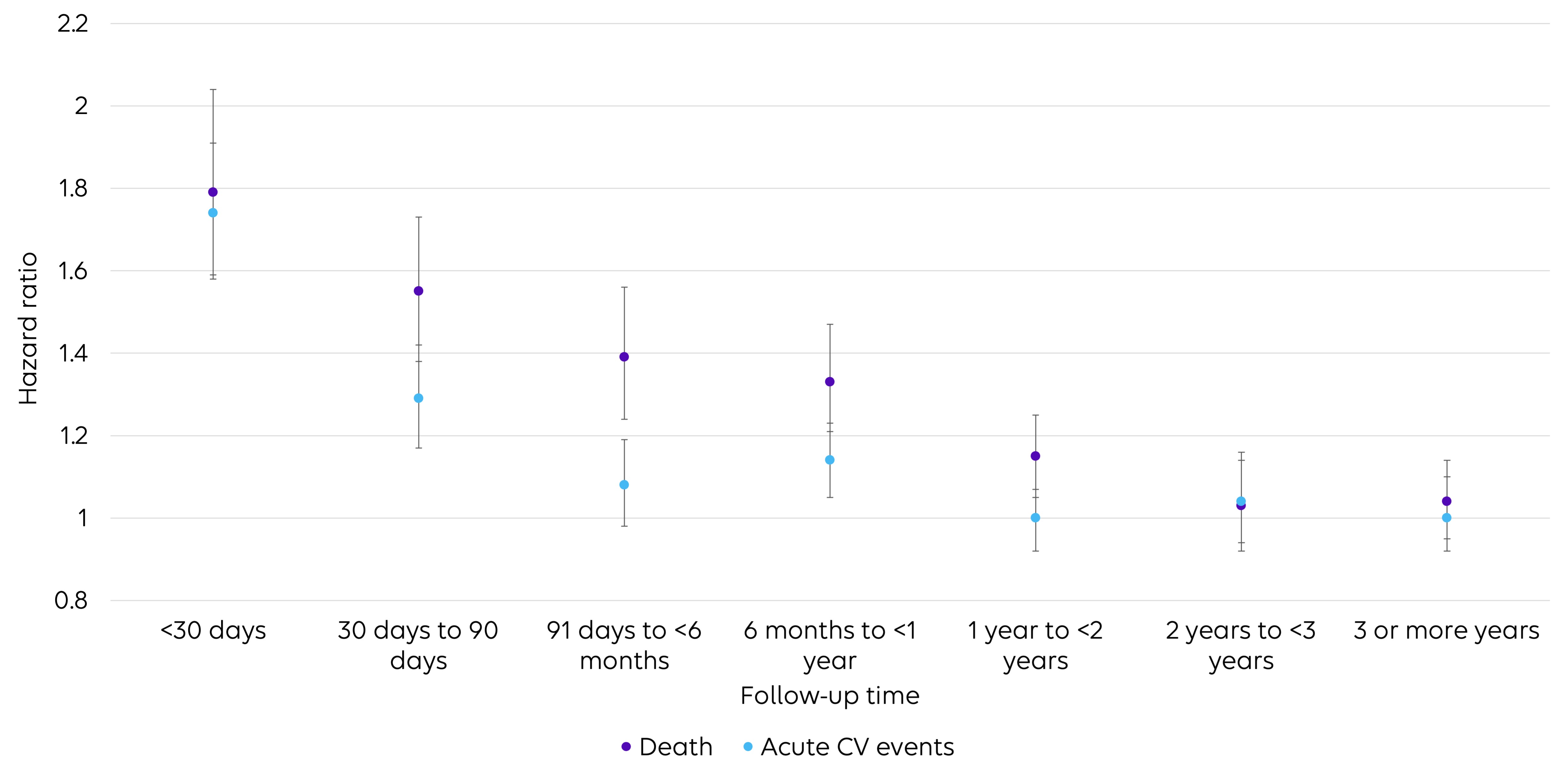
Figure 2. Subgroup analyses estimating the hazard of death by severity and number of AECOPD
Publications
Carelon Research project team: Kimberly Daniels, Arlene Tave, Stephan Lanes, Amanda Neikirk*
*Carelon Research associate at the time of the study.
For more information on a specific study or to connect with the Actionable Insights Committee,
contact us at [email protected].
This study was conducted by Carelon Research, Inc., a subsidiary of Elevance Health, and funded by AstraZeneca. Dissemination and sharing of the Newsletter is limited to Elevance Health and its subsidiaries and included findings and implications are for Elevance Health and its affiliates’ internal use only.
Lorem ipsum dolor sit amet, consectetur adipisicing elit, sed do eiusmod tempor incididunt ut labore et dolore magna aliqua. Ut enim ad minim veniam, quis nostrud exercitation ullamco laboris nisi ut.
Lorem ipsum dolor sit amet, consectetur adipisicing, sed do eiusmod tempor incididunt ut labore et dolore magna aliqua. Ut enim ad minim veniam, quis nostrud exercitation ullamco laboris nisi ut. Ut ad minim veniam.
Vestibulum ante ipsum primis in faucibus orci luctus etel ultrices posuere cubilia Curae.
Lorem ipsum dolor sit amet, consectetur adipisicing elit, sed do eiusmod tempor incididunt ut labore et dolore magna aliqua. Ut enim ad minim veniam, quis nostrud exercitation ullamco laboris nisi ut.

Sed ut perspiciatis unde omnis iste natus error sit voluptatem!

Nemo enim ipsam voluptatem quia voluptas sit odit aut fugit!

Ut enim ad minima veniam, quis nostrum exercitationem ullam!

"Et harum quidem rerum facilis est et expedita distinctio!"

"Nam libero tempore, cum soluta nobis est eligendi."

"Temporibus autem quibusdam et aut officiis debitis!"