 Health-related social needs and whole person health
Unmet health-related social needs (HRSNs) can be a barrier to achieving whole person health. Elevance Health developed a pilot survey to assess the prevalence of these needs among its affiliated health plan members in two states, and then linked respondents’ survey data with their claims data to evaluate how such needs relate to health, utilization, and spending. Enterprise Analytics Core domain(s): Whole person health, community health (SDoH) Summary Source: Author calculations from Elevance Health's Social Risk Survey. Source: Author calculations from Elevance Health's Social Risk Survey linked with administrative claims data. Key takeaways
Background
HRSNs refer to unmet social needs, such as access to healthy food, quality housing, or reliable transportation, and are associated with poorer health outcomes. A health systems’ limited information on individuals’ HRSNs can hinder the ability to fully achieve a whole health approach. Although commercially insured adults comprise approximately two-thirds of the U.S. adult population, they are the least likely to be surveyed about their social needs. Thus, little is known about the prevalence of HRSNs in this population. This analysis reports only on findings pertaining to commercially insured Elevance Health members.
This pilot survey assessed the prevalence of HRSNs among commercially insured Elevance Health members in two states, and then linked their survey and claims data to evaluate how such needs relate to health, utilization, and spending.
Methods
In this cross-sectional study, we utilized survey data from commercially insured adult members residing in Georgia and Indiana. These two states were selected to provide geographic and demographic diversity. A stratified quota probability sampling strategy was implemented to ensure each state’s commercially insured survey respondents were representative of their respective state’s commercial health plan membership by gender, age, social vulnerability index (SVI) ranking, and urbanicity of residence.
The survey was based on extant health and social need screening tools and questions, including the PRAPARE Screening Tool, the CDC Healthy Days Measure, and questions from the HRSN Screening Tool. Respondents were considered to have a specific HRSN if they indicated need through their response to at least one of the relevant survey questions. Self-reported health was assessed through the CDC Healthy Days Measure in which respondents reported the number of physically and mentally unhealthy days during the 30 days prior to the survey.
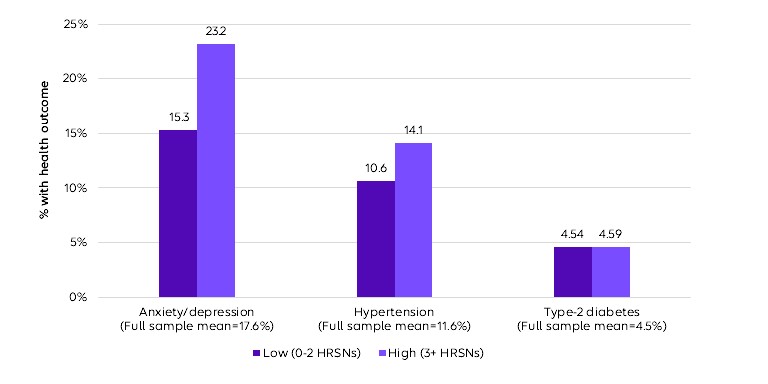
HSRNs were measured across nine different domains (Figure 1): healthcare access, financial wellbeing, internet access, housing quality, healthy food access, interpersonal safety, housing stability, reliable transportation, and social support. Survey data were linked to medical claims data in Carelon Research’s Healthcare Integrated Research Database (HIRD®), and regression models were used to estimate the relationship between HRSNs and self-reported health, emergency department visits, three major health outcomes (anxiety/depression, hypertension, and type 2 diabetes), and healthcare costs (medical and pharmaceutical).
Results
Figure 1. Prevalence and number of health-related social needs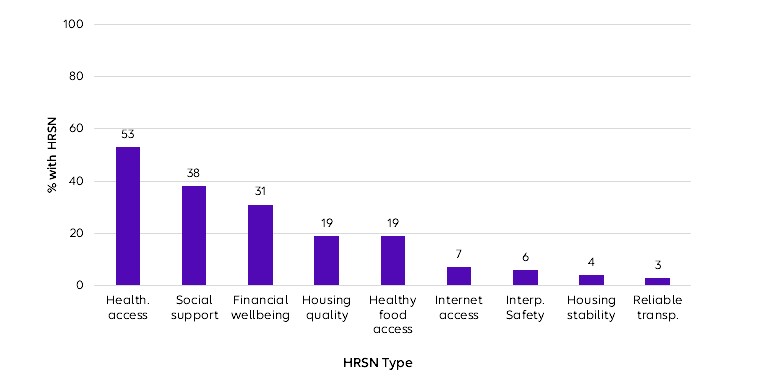
Panel B. Prevalence of the count of health-related social needs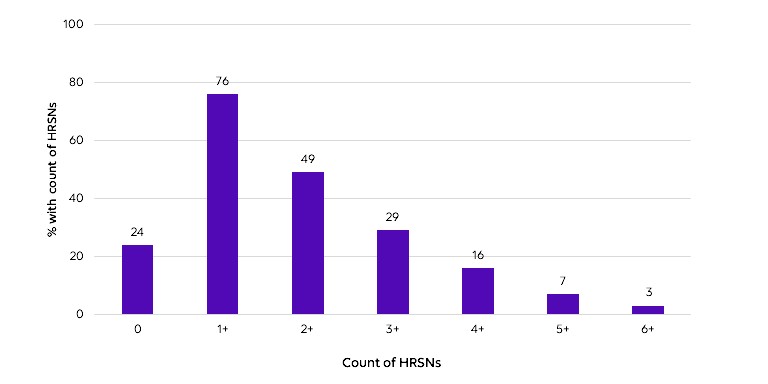
Figure 2. Self-reported health and healthcare outcomes by number of health-related social needs 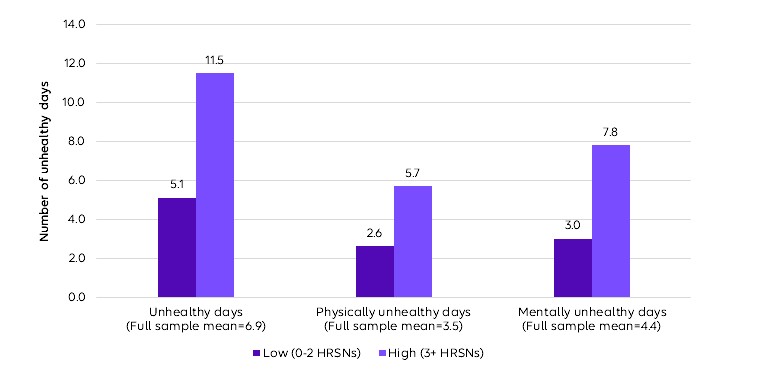
Panel B. Healthcare outcomes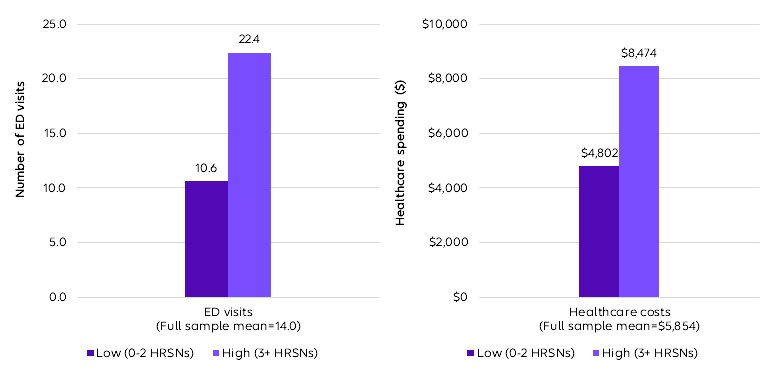
Publications
Carelon Research Co-PI: Judith (Judy) Stephenson
For more information on a specific study or to connect with the Actionable Insights Committee,
contact us at [email protected].
This study was conducted by Carelon Research, Inc., a subsidiary of Elevance Health, and funded by Elevance Health. Dissemination and sharing of the Newsletter is limited to Elevance Health and its subsidiaries, and included findings and implications are for Elevance Health and its affiliates’ internal use only.
Lorem ipsum dolor sit amet, consectetur adipisicing elit, sed do eiusmod tempor incididunt ut labore et dolore magna aliqua. Ut enim ad minim veniam, quis nostrud exercitation ullamco laboris nisi ut.
Lorem ipsum dolor sit amet, consectetur adipisicing, sed do eiusmod tempor incididunt ut labore et dolore magna aliqua. Ut enim ad minim veniam, quis nostrud exercitation ullamco laboris nisi ut. Ut ad minim veniam.
Vestibulum ante ipsum primis in faucibus orci luctus etel ultrices posuere cubilia Curae.
Lorem ipsum dolor sit amet, consectetur adipisicing elit, sed do eiusmod tempor incididunt ut labore et dolore magna aliqua. Ut enim ad minim veniam, quis nostrud exercitation ullamco laboris nisi ut.

Sed ut perspiciatis unde omnis iste natus error sit voluptatem!

Nemo enim ipsam voluptatem quia voluptas sit odit aut fugit!

Ut enim ad minima veniam, quis nostrum exercitationem ullam!

"Et harum quidem rerum facilis est et expedita distinctio!"

"Nam libero tempore, cum soluta nobis est eligendi."

"Temporibus autem quibusdam et aut officiis debitis!"